Image: Ad Meskens
The first centuries of Christianity weren’t just formative – they were explosive. From battles over belief to the courage of martyrs, the early Church forged the doctrines, practices and stories that still shape faith today. Nigel Scotland explores why going back to the beginning matters for Christians today.
From the Roman emperor Constantine through to Martin Luther and the British Prime Minister William Gladstone there have been many keen students of early Christianity. Radicals such as Kier Hardie, the founder of the Labour Party, and Tony Benn have derived a good deal of their inspiration from the early Church’s concerns for social justice, charity, practical care and support of the marginalized.
History and historical events are the life blood of the Christian faith. The Christian understanding of salvation is dependent on them; in particular that God came to Earth in the person of Jesus (incarnation), lived, died and rose again. That he ascended into heaven from where he poured out his Holy Spirit presence on the Church.
Early Christian history is particularly important because it wasn’t until the mid-fifth century that the Church was anything approaching fully developed and its major doctrines agreed. It was in this period it that the Church decided which apostolic books would form the New Testament as we have it today. After a long battle which lasted much of the fourth century, the Church was prompted and thrust forward by the Roman emperors, most notably Constantine and Theodosius the Great. Both accepted that the Father and the Son were one and the same divine essence or substance. Jesus was and is “God from God”, “light from light” and just in case we missed it “very God of very God”.
By the second decade of the fifth century, the Church had reached a much clearer understanding of the doctrine of the Trinity. Father, Son and Holy Spirit were not to be seen as three separate individuals (tritheism). This was a misunderstanding arising from the writing of North African theologian Tertullian who designated the Father, Son and Spirit as three “Persons”; the word wrongly being taken by many to mean people. Although the term “person” continued to be used in the three historic creeds the great early theologians were clear that Father, Son and Holy Spirit are “distinctives” or “individualities” of the one God. Put another way God is a tri-personal being. Christian believers can know and experience His presence in three personal ways all at the same time together or on some occasions there will be a greater sense one of a generous father or a forgiving Jesus walking beside. This doctrine is something that contemporary preaching, which often appears to be a form of ditheism (Jesus and the Father proclaimed as though they were two separate individuals), needs to get hold of.
It was during the first four centuries that the Church settled and agreed on the three great historic Creeds of the Christian faith: the Apostles Creed, the Nicaean Creed and the Athanasian Creed. Rooted in the New Testament Gospels and letters they have a central focus on the doctrines of the Trinity and salvation. Through the centuries these three creeds have been, and still are recited in Catholic, Orthodox and Anglican churches. Most other mainstream Protestant denominations, while not using creeds in their public worship, still assent to their doctrine.
Alongside the formation of these creeds, the early churches developed the teaching of apostolic scriptures into doctrines, worship and practices which both Christian believers and others who wanted to join the Church were expected to adopt and practice in their daily living. Many of them were written down in apologies, tracts, manuals. and catechisms. There were changes from the early understanding of both the Lord’s Supper and Baptism. The former following Jesus’ teaching at the Last Supper began as an informal homebased Passover-style meal with the sharing of bread and wine separated by an agape meal. Later, particularly after religious toleration, it became formalized with structured liturgies presided over by a priest in a public building. Baptism, which in the earliest times was often performed by immersion shortly after a person had professed faith in Jesus, gradually came to be delayed as new believers were given a period instruction before the sacrament took place. Later baptism of children began and the water was believed by some to effect spiritual cleansing.
The events of early Christian history and the biographies of early leaders and theologians can inspire, encourage and inspire the faith and witness of members of contemporary churches. What God’s people accomplished in the past can happen again in the present. The courage, faith and bravery of literally hundreds of thousands of early Christians and their leaders who died in the first three centuries by execution, crucifixion, public burnings and being thrown to Lions in public arenas will probably never be equalled. All for the simple reason that they refused to declare “Caesar is Lord” before the local magistrates. For them it was Jesus alone who was “Lord”, indeed “Lord of Lords”! Remarkably the witness of their deaths saw the church grow and flourish to such an extent that Tertullian remarked, “The blood of the martyrs is the seed of the church”.
The study of early Christianity is also vital because it enables today’s churches to see how the early Christians shaped, developed and modelled their leaders. Some advocated a priestly, sacramental or shepherding office, while for others the emphasis was on a pastoral, teaching, prophetic or servant ministry. Closely related to this the early Christians developed differing styles of organization. Some early fellowships were part of a system which embraced the pre-Christian diocesan areas of the secular Roman provinces while others were enjoyed more independency and fell in with groups such as the Montanists and Gnostics. A knowledge of the strengths and weaknesses of these and similar and early movements remind us that “those who fail to learn the lessons of history are destined to repeat them”.
Early Christianity provides us with many resources for worship, prayer, meditation and spiritual guidance. These include the Letters of Ignatius of Antioch, the writings of the Desert Fathers and Antony the Great, the Prayers of St Ephrem, the Confessions of Augustine and the Rule of Benedict.
In conclusion, it has to be said that the first four centuries were, and are, supremely formative in the history of the Christian faith. It was the time in which the Church was born and sprang into life with all the twelve apostles travelling across the Roman Empire proclaiming the news of the gospel. The second and third centuries saw the Christian Church overcome false teaching within and horrific persecution for without and yet it expanded hugely in numbers. Finally, following the conversion of Constantine, Christianity became the official religion of the Roman empire. Every Christian leader and serious Christian believer needs to know the solid ground of the faith which can only come with an understanding of early Christianity.
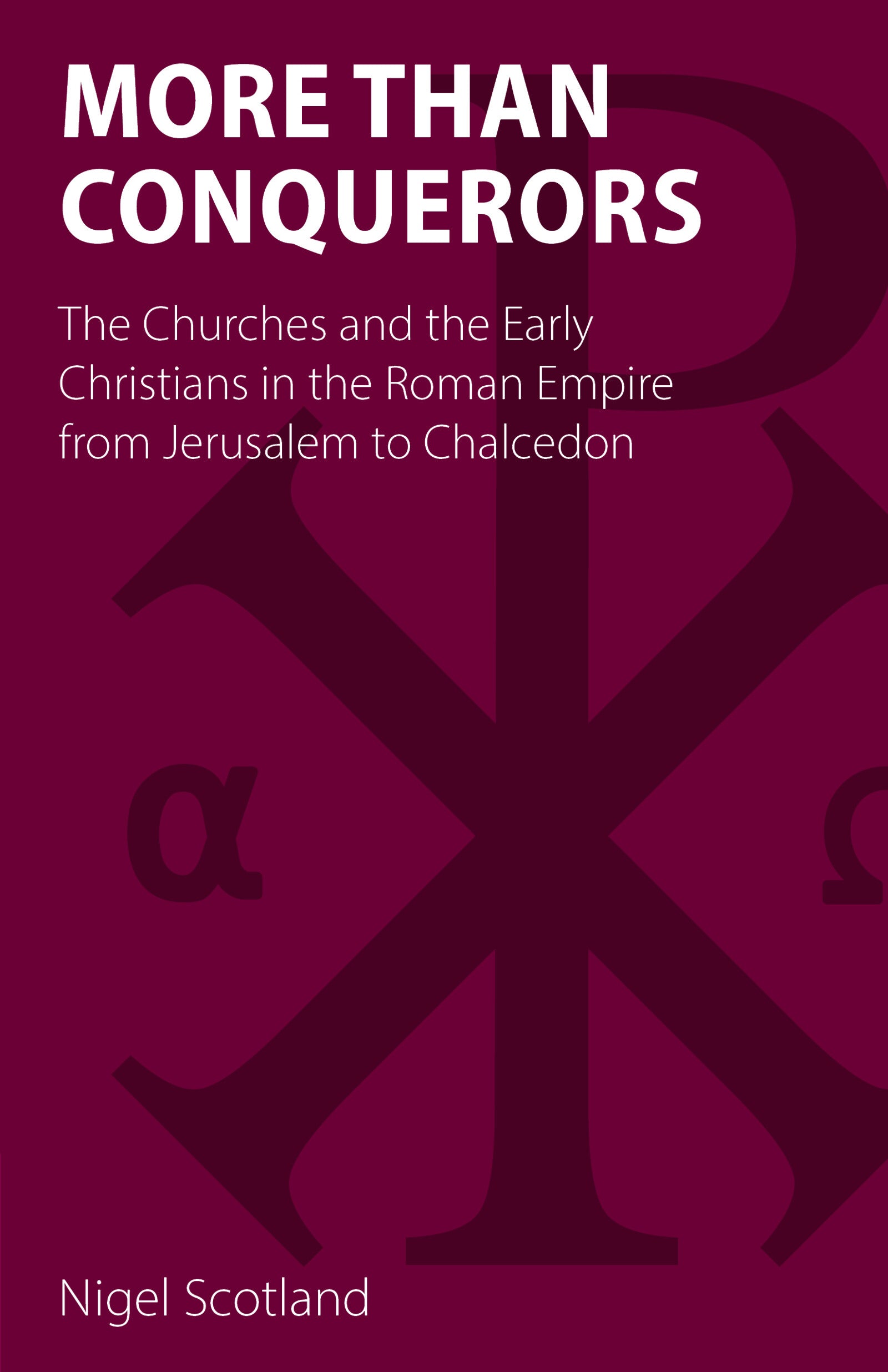
More than Conquerors by Nigel Scotland is a fascinating history of early Christianity from the day of Pentecost to the fifth century, and is available now in paperback and e-book.