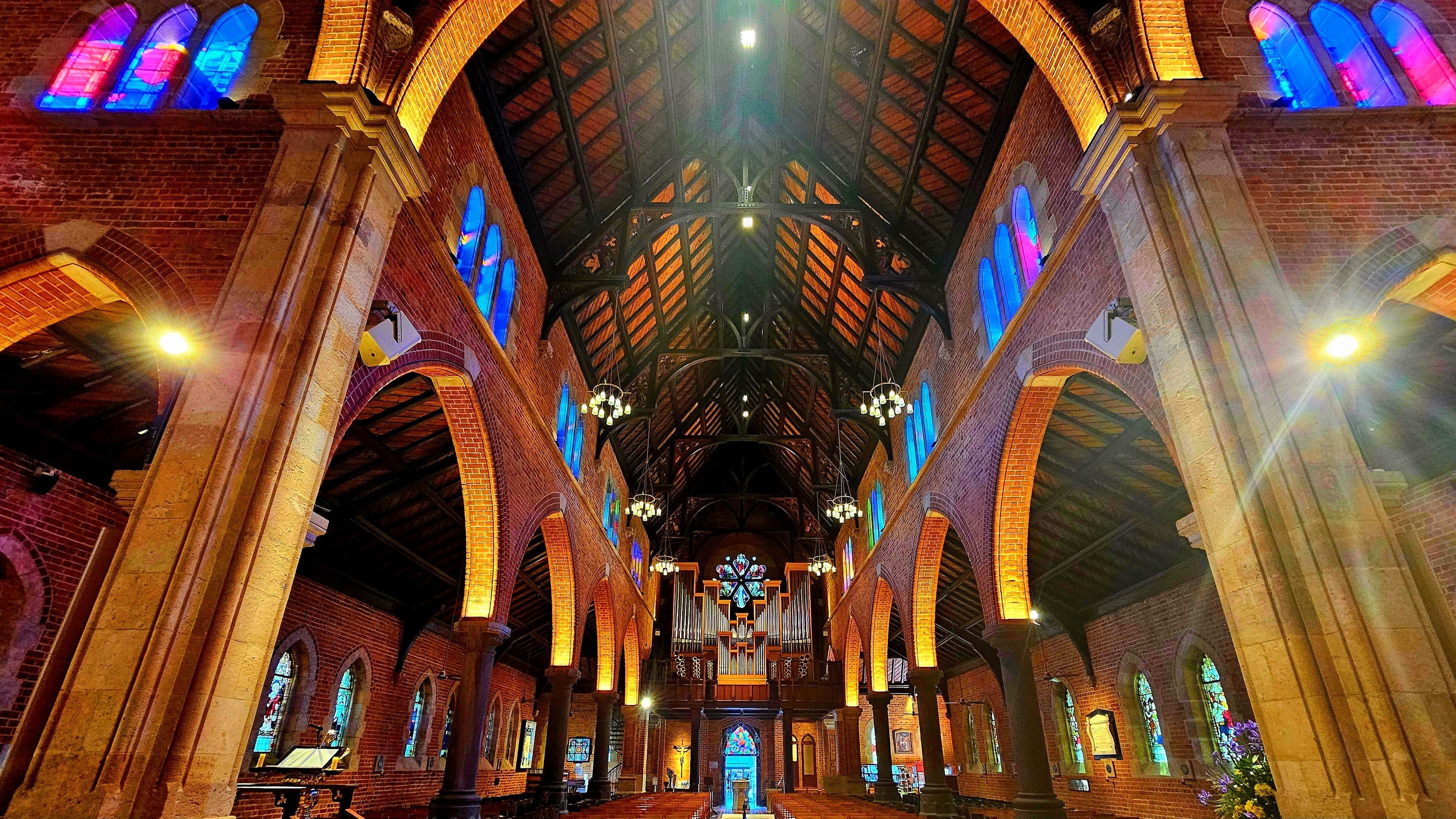
Photo: Simon Day, St George's Cathedral, Perth
Canon Dr Arthur Edwards explores John Shepherd’s study of Anglican worship, showing how music, liturgy, and theology developed from the Reformation to the Caroline divines to shape the “beauty of holiness”. By examining figures from Hooker and Donne to Laud and Cosin, it traces the shift from worship as remembrance to worship as an embodied encounter with the divine – prompting us to rethink the role of beauty, music, and mystery in Christian devotion.
John Shepherd’s well-researched and well-written book starts from the premise that medieval eucharistic worship (the Mass) embodied the living presence of the divine because of the offering of Christ upon the altar as a continuation of the offering of Christ upon the Cross of Calvary. The ‘physical, embodied presence of Christ’ upon the altar made clear the reality of the divine presence.
The reformers denied that Jesus was physically present in the consecrated elements of bread and wine (transubstantiation), but he was really and spiritually present as the bread and wine were offered in remembrance of his one perfect sacrifice for the sins of the world. The sacrifice of Jesus on the Cross of Calvary was made once for all. It was unique and could not be repeated or improved by any means, liturgical, visual, architectural or musical. It is with what he sees as the undermining of the musical contribution to the transcendence of worship brought about by the eucharistic doctrine of the sixteenth-century reformers that John Shepherd’s book is most concerned. John Shepherd presents the eucharistic doctrine enshrined in the Book of Common Prayer as what he calls a stark reversal of the doctrine of the Middle Ages, which sought to reiterate a sacrifice. The prayer book sacrifice was one of “praise and thanksgiving” in response to Christ’s unique sacrifice. Christ’s entire satisfaction and propitiation for the sins of the whole world meant that no further propitiation could be made. From the published homilies and the preaching of sermons it seemed that edification had replaced acts of devotion and liturgical expression of the divine presence.
John Shepherd acknowledges that by the time of Queen Elizabeth, music was able to be preserved in worship with the authority of the Royal Injunctions of 1559, but music was to convey meaning rather than mystery. The special importance of preaching was not to be compromised by music. No less a musician than Merbecke insisted that Christ’s was the only legitimate sacrifice and the offering of music or any other work of art to supplement this was no longer appropriate. Musicians were to be taught the Catechism and to receive religious education. Their music could enhance their education. The singing of metrical psalms by the whole congregation by alternate sides (antiphonally) was embraced by Archbishop Matthew Parker who wanted music to be understood. The use of organs in churches was becoming more general.
John Whitgift, who became Archbishop of Canterbury in 1583, believed that music enhanced faith and he argued against the Puritan Thomas Cartwright that the ceremonies, including organ-playing and singing, did not detract from the sacrament. John Shepherd’s argument in favour of the importance of music in achieving the beauty of holiness in worship, is strengthened by Richard Hooker (1554–1600), who believed that “whilst it was Christ’s perfect sacrifice alone that remained the indisputable foundation of salvation, it was never intended that the offering of works should be precluded from worship”. Hooker believed that because humanity was integrated into the nature of Christ, humanity’s offering of worship became thoroughly integrated into Christ’s offering. The worship of heaven and earth were joined and the ceremonial consistent. This was a radical departure from the teachings of the reformers.
The second half of this book provides chapters on Bishop Lancelot Andrewes (1555–1626) and Bishop John Buckeridge (1562–1631). For them music was a divinely appointed means of unity between the human and the divine; they believed that works of beauty were incorporate in Christ’s offering and pleasing to God. There was a unity between the human and the divine. The offering of works (music) was acceptable to God but had no propitiatory effect to add to Christ’s sacrifice. For John Donne (1572–1631), the offering of worship had a propitiatory quality. The offering of worship could be united with the offering of Christ, because divine forgiveness had overcome the force of human sin. He believed in a complementarity of faith and works in an offering of worship which was both physical and spiritual. Donne believed in the liturgical reality of Christ’s presence, though the sacrifice which Donne regarded as authentic was not a re-enactment of Christ’s original sacrifice, but the mystery of God could be experienced in worship and worship united earth and heaven.
This is all grist to the mill for John Shepherd as he moves on to provide further chapters on the Caroline divines, whose eucharistic theology is far removed from that of the Reformation. William Laud (Archbishop of Canterbury 1633–45) had a view of the significance of worship which aligned it more closely with the offering of Christ. It contrasted with the eucharistic doctrine of the Book of Common Prayer. John Shepherd claims it to be of pre-Reformation significance. Laud’s Visitation Articles were particularly concerned with the high quality of musical standards that he expected. For Robert Sanderson (1587–1663) worship was meant to glorify God and was represented most naturally in the formal liturgical worship of the Church. In spite of human sin, the offering of music was accepted by God. John Cosin (1594–1672), who became bishop of Durham in 1660, referred to John Chrysostom, fourth-century bishop and doctor of the Church, to support his belief that the sacrifice offered by the Church in worship not only commemorated Christ’s sacrifice, but “was as propitiatory for human sin as Christ’s original sacrifice”. At the same time, Cosin argued that the sacrifice of the liturgy was not a re-iteration of the sacrifice offered on the cross, but it made Christ’s offering present and not just a memory. Cosin valued music as an essential part of the offering of worship.
In Chapter 12, John Shepherd presents us with the picture of worship as a sharing in the worship of heaven: “the elements of worship, such as ritual, the arts and music, came to be valued as embedded in this unity of the divine and the human”. As beauty “was an inherent quality of the worship of heaven, so beauty was to be an inherent quality of the worship of the Church”. This view was supported by Anthony Sparrow (1612–85), Giles Widdowes (1588–1645) and Thomas Westfield (1573–1644), who argued that music was an indispensable part of worship on earth as it was in heaven, and it should be of the greatest beauty. In his final chapter, John Shepherd presents the views of Robert Skinner (1591–1670), Jeremy Taylor (1613–1667), and John Gauden (1605–62) to show that through divine forgiveness for human sin, it was possible for the offering of worship in both its physical and spiritual aspects to become absorbed in the divine presence and raised from the human to the divine. As the quality of beauty was inherent in the holiness of heaven, so holiness was inherent in the beauty of earthly worship. So, concludes John Shepherd, Christ’s offering was made personally effective through the worship of the Church, which was an embodiment, rather than a remembrance of the divine, and brought a deeper recognition of the experience of transcendence. This involves an understanding of the development of the dynamics of worship from the time of the Prayer Books of the sixteenth century.
As someone who has experienced the transcendence of good worship, particularly in some Anglican cathedrals, I can support John Shepherd’s claims for the place of beautiful choral music and correct liturgy, though I should also add the importance of good preaching. It could be argued that some Anglicans and other Christians prefer to worship, and even to experience the mystery of God without musical accompaniment. There must also be reservations about some musicians who seem to be uncommitted to the reality of the divine presence. There are two words which I wish that John Shepherd had explored further. The one is “remember” when applied to the “remembrance” (anamnesis) of Christ’s unique sacrifice on the cross, and the other is “response” to that offering (ourselves our souls and bodies). Nothing can add to the effect of Christ’s offering, not even the most beautiful music, but long may that music and those who produce it, continue to add to the beauty of holiness and the holiness of beauty.
The Revd Canon Dr Arthur Edwards is a retired priest in the Church in Wales. Worship and the Mystery of God: Anglican Divines and the Reality of the Divine Presence is available now in paperback and e-book.